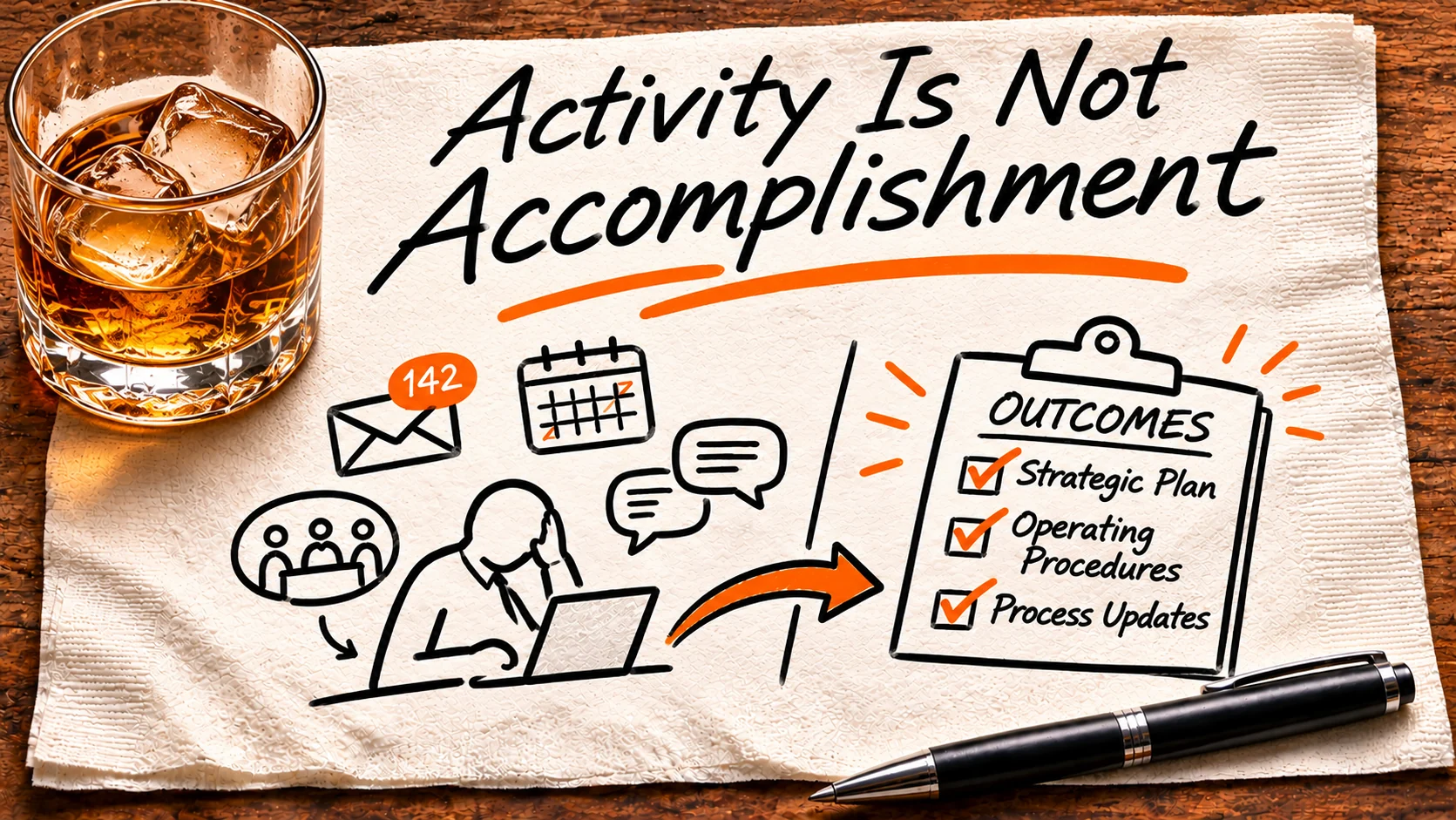
Imagine asking someone how their week went at work. They tell you how incredibly busy they’ve been. Their calendar has been packed with meetings, their inbox is overflowing, and they’ve barely had time to eat lunch. They’ve been coordinating with stakeholders, attending briefings, responding to emails, and, of course, communicating, communicating, communicating.
But when you ask what they actually accomplished, the conversation becomes a little more difficult.
In his book A World Without Email, Cal Newport introduces the concept of the “hyperactive hive mind,” a way of working characterized by constant, unstructured, back-and-forth communication. The problem isn’t necessarily the technology we’re using to communicate. It’s that we’ve allowed talking about work to consume much of the time available to perform the work itself.
Here’s an interesting exercise: Pull out your position description. Does it simply say that you’re responsible for attending meetings, responding to emails, and communicating with colleagues? Or does it identify responsibilities that should result in tangible outputs and organizational outcomes?
More importantly, what have you produced recently that demonstrates you’ve fulfilled those responsibilities?
Leadership is not exempt from this question. At the strategic level, leaders should be producing and maintaining strategic plans, establishing organizational direction, and making decisions about resource allocation. At the operational level, leaders should be developing, evaluating, and refining the processes and operating procedures that enable their people to perform.
Consider what happens when an employee encounters a recurring problem within a process. Leadership schedules a meeting, discusses the issue, sends a follow-up email, and reminds everyone to communicate better. A few weeks later, the same problem occurs, and the cycle repeats itself.
Has anyone actually examined the process or updated the operating procedure to prevent the problem from recurring? If not, what did all that activity accomplish?
This isn’t an argument against meetings, email, or communication. These are necessary activities that facilitate collaboration and organizational performance. The problem arises when we begin treating these activities as evidence of performance rather than as a means of achieving it.
The next time someone asks how your week went, consider whether your response describes how you spent your time or what you accomplished with it.
There is a significant difference between the two.
A full calendar and an empty inbox are not necessarily indicators of a productive organization.
Truth Improves Performance.