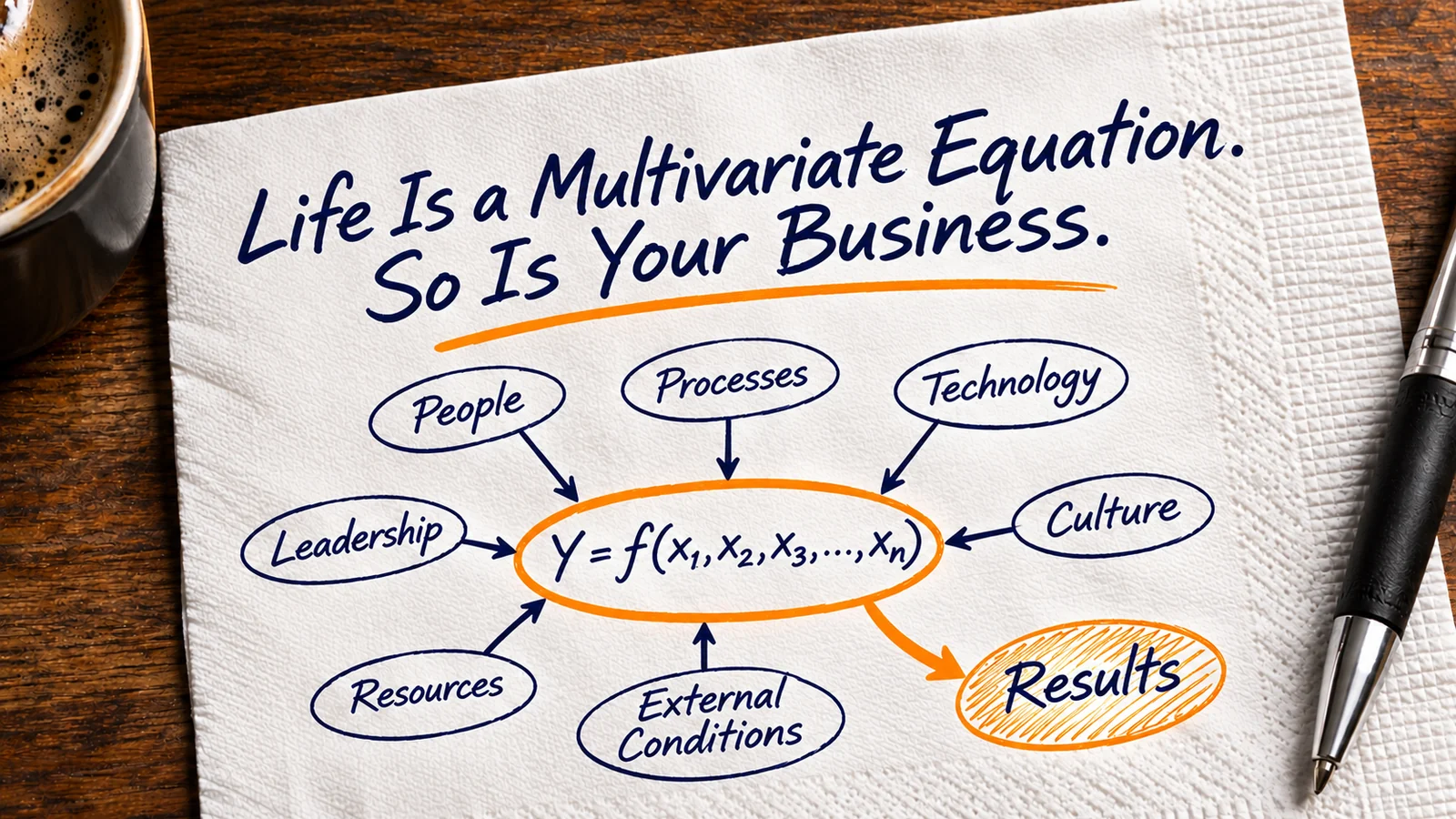
My father, Harold G. Campbell, PhD, had a saying that has stuck with me throughout my life: “Life is a multivariate equation.” He even wrote a book titled Why: The Philosophy and Science of Multivariate Reasoning, exploring how multiple variables influence the world around us.
For those who haven’t taken a statistics course in a while, multivariate reasoning involves recognizing that outcomes are influenced by multiple variables rather than a single factor. Change one variable, and you may influence several others. Sometimes the relationships are obvious. Other times, not so much. While my father approached this concept from a philosophical and scientific perspective, I’ve found it particularly relevant when examining organizational performance.
Think about the last time your organization experienced a performance problem. Maybe employee productivity declined, customer satisfaction dropped, or a department consistently failed to achieve its objectives. What was the proposed solution? More training? New software? Leadership development? Process improvement? Perhaps another organizational restructuring?
Imagine an organization with several highly qualified professionals responsible for improving performance. An instructional designer identifies a knowledge gap and recommends training. An organizational development consultant recognizes leadership challenges and recommends coaching. A Lean Six Sigma practitioner identifies process inefficiencies and recommends streamlining operations. Each professional approaches the situation through the lens of their respective discipline, drawing upon established methodologies and years of experience.
Who’s right? Potentially all of them. But that doesn’t necessarily mean any one of them has identified the problem.
Throughout my career, I’ve worked alongside talented professionals representing numerous disciplines, each bringing their own knowledge, experience, and professional standards to the table. I’ve also witnessed organizations struggle to achieve meaningful improvements despite having those resources readily available. The challenge wasn’t necessarily a lack of expertise. Sometimes it was the absence of a consistent approach to understanding the problem, determining which variables contributed to it, and evaluating whether the selected interventions actually improved performance.
Consider an organization that invests thousands of dollars developing training programs to address employee performance, only to discover that employees already know how to perform their jobs. The actual problem might involve conflicting policies, outdated technology, unclear expectations, or leadership decisions that unintentionally create barriers to success. The training might be excellent, the instructional designer might have followed every industry standard, and employees might even report that they enjoyed the experience. But did organizational performance improve?
This is where my father’s observation becomes particularly relevant. Organizations are complex systems consisting of people, processes, technology, leadership, culture, and numerous other variables that influence one another. Examining any one of those variables independently may provide valuable information, but it doesn’t necessarily explain the organization’s overall performance. Just because someone has an advanced degree, professional certification, or twenty years of experience doesn’t mean their particular discipline provides the answer to every organizational challenge. That includes consultants.
At APX Consulting, we recognize that organizations frequently possess the expertise necessary to resolve their own challenges. They may already employ instructional designers, organizational development professionals, process improvement specialists, and experienced executives. Sometimes what’s missing isn’t another specialist or another solution. It’s an objective examination of the problem through multiple lenses before deciding which intervention, if any, is appropriate.
Our role isn’t to walk into an organization with a predetermined answer. It’s to help leadership understand what’s actually happening, identify the variables influencing performance, and make informed decisions about what deserves their attention and investment. Sometimes that means confirming what leadership already suspects. Other times, it means challenging assumptions that have gone unquestioned for years. Either way, the objective remains the same: improving organizational performance.
My father was one of many people who influenced how I learned to think about the world. His perspective wasn’t the only one, nor should it be. In fact, that would contradict the very concept he spent so much time exploring. His observation, however, provides a useful reminder for anyone responsible for leading an organization.
The next time someone presents you with a problem and immediately recommends a solution, ask yourself one question: Have we considered all the variables, or are we simply looking at the problem through the lens we’re most comfortable using?
Because sometimes the answer isn’t wrong. It’s just incomplete.
Truth Improves Performance.