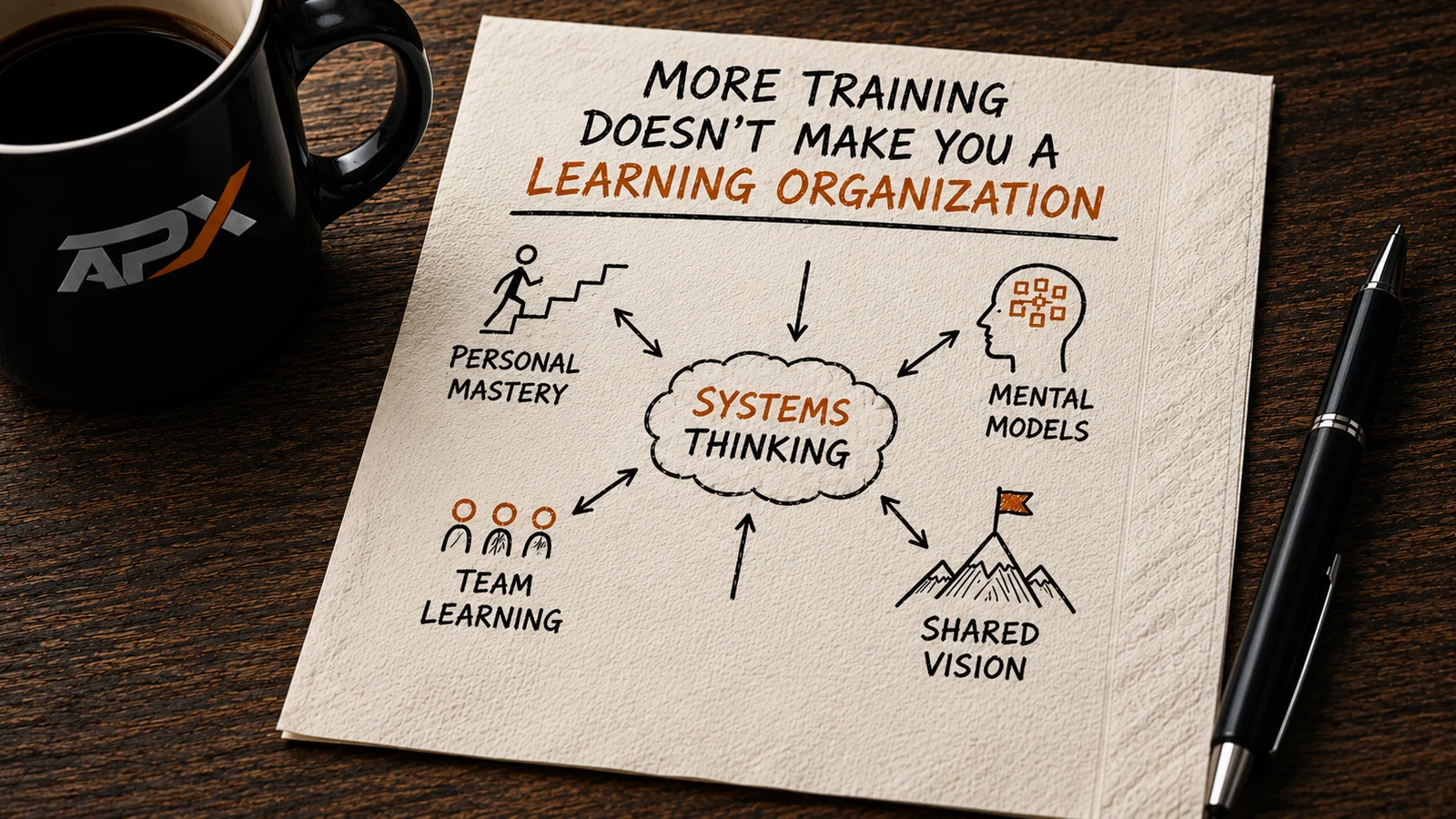
One of my favorite references is Peter Senge’s The Fifth Discipline: The Art and Practice of a Learning Organization. There is a lot to unpack in his contributions, but he characterized five disciplines learning organizations should put into practice (Systems Thinking, Personal Mastery, Mental Models, Building a Shared Vision, and Team Learning).
In my “Same Stimulus. Different Perceptions. Different Response.” post, I provided an example of different C-suite members’ perceptions for resolving an issue related to the increase in complaints. In that particular example, leadership provided three different solutions, all of which would have an impact on correcting the underlying issue. However, that would be three potentially costly interventions to resolve what could be perceived as a simple issue. In addition, the implementation of three interventions could result in unintended consequences that cause greater issues than they initially set out to resolve.
“Systems thinking is a discipline for seeing wholes. It is a framework for seeing interrelationships rather than things. For seeing ‘patterns of change’ rather than static ‘snapshots.’”
Of the five disciplines, I believe Systems Thinking is the one that matters the most, because without it, silo building becomes inevitable.
With a Systems Thinking mindset, Senge is suggesting that an organization cannot simply focus on the forest or the trees, but rather both. Leaders tend to grow in a technical specialty with a light sprinkling of leadership development as they progress through the organizational hierarchy or by lessons learned as they go from company to company. Eventually, you find your way to a position where your technical expertise is only a fraction of what you need to know to lead at a cross-functional level. And the higher you are, the more functions you need to understand.
During one of my assignments, I was tasked with the procurement of an enterprise-wide Learning Management System (LMS). In a small organization this would seem like a fairly simple task; do some market research, find the ones that best fit your business needs, write a check, and implement. But the larger the organization, the more systems thinking is necessary. As a former Information Technology guy, I thought I had a grasp on the IT business, but was quickly indoctrinated into a Software Development Life Cycle (SDLC) that required the documentation of several aspects. In addition to generating functional documentation, this required insights into the details of not only the training business, but cybersecurity compliance, contracting, logistical integration, technical evaluation, policy and procedure updates, and so on.
As I fumbled my way through this process, I was building my own Personal Mastery across these various functions and challenging some of my Mental Models about how an enterprise system actually gets implemented. More importantly, none of us could accomplish the work independently. It required people from different functions to learn from one another, develop a shared understanding of what we were trying to accomplish, and recognize how decisions within one area affected the others.
The lesson wasn’t that I needed to become an expert in cybersecurity, logistics, contracting, or every other function involved. I needed to understand how those functions interacted with the system I was responsible for implementing.
A Learning Organization isn’t created by providing more training. It’s created when people continue developing their own capabilities, challenge their assumptions, learn together toward a shared vision, and understand how their decisions affect the larger system. That’s why Senge didn’t call his book The First Four Disciplines. Systems Thinking is the Fifth Discipline because it connects the others.
Truth Improves Performance.