In a Louder with Crowder podcast, Dr. Jordan Peterson said, “We are always faced with the problem of perception and action. We have to see the world. We have to hear the world. We have to interact with the world through our senses and we have to act. None of that is optional. And even to perceive something you, have to select what's important and what isn't. So, if you listen to someone in a crowded room, you focus in on their speech and not on the speech of the people in the background. And so, you prioritize that person’s speech in the hierarchy of value that guides your perception. Well, so you're stuck with existing inside a system of values. There is no way out of that.” (Peterson, 2021, 35:49).
In the last Back of the Napkin post, I discussed how amazing humans are because of what our brains can do for us. We are, in most instances, intelligent and evolve as we learn from our interactions. But what happens when we combine human beings together in a pair? Do they cooperate in unison? Do they have conflict? Does one try to influence the other? What happens when you add several people together into a small team? What about an entire organization full of employees?
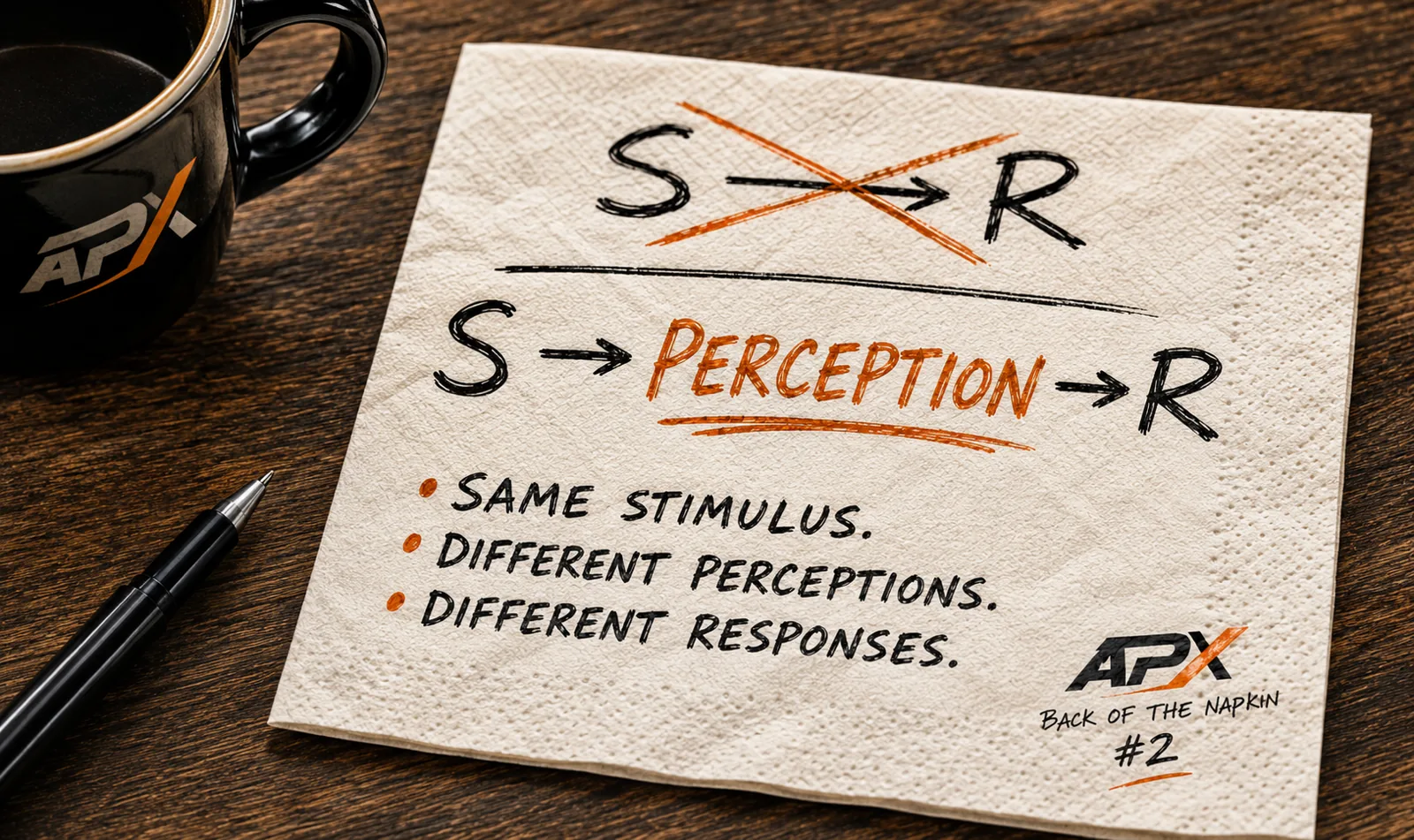
Most organizations assume people are responding to reality, but they aren’t. They’re responding to their perception of reality and the distinction matters. You can have two leaders attend the same meeting, hear the same information being presented, see the same data points listed on a PowerPoint, and observe the same behavior, but walk away from the meeting with two completely different conclusions. Why is that? Because perception is selective, we don’t experience everything, we experience what we notice, and what we notice is influenced by our experience, assumptions, priorities, incentives, fears, and values.
Imagine you’re an executive leader, sitting at the head of the conference table with your C-suite team and are presented with information that complaints are beginning to increase. You all received the same data, but your Chief Learning Officer determined employees need customer service training. Your Chief Human Resources Officer concluded that staffing levels are inadequate. And your Chief Operations Officer concluded the process itself is creating frustration for customers. Same stimulus. Different interpretations. Different responses. Everyone leaves the conference table and begins implementing solutions based on their interpretations of the problem. The organization ultimately invests in costly interventions before determining which interpretation is correct, often creating more unintended consequences than the original problem.
The challenge most organizations face isn’t that employees are irrational; it’s that their responses begin with their perceptions. If those perceptions are incomplete, even well-intentioned solutions can miss the mark. That’s why performance improvement starts with understanding how people are interpreting the situation before prescribing solutions.
Truth Improves Performance.