In Symptoms Are Expensive. Root Causes Are Profitable., I discussed the complexities of an organization and referenced Dempsey and Kaufman’s models as a means to better understand where value is added at each level. Those who reside within senior-level roles should typically provide Strategic-level efforts that align an organization’s Return on Investment (ROI) with societal contributions. Those hired to lead execution at the Operational level should focus on managing the organization’s internal processes and leading those hired at the Tactical level who perform the day-to-day duties.
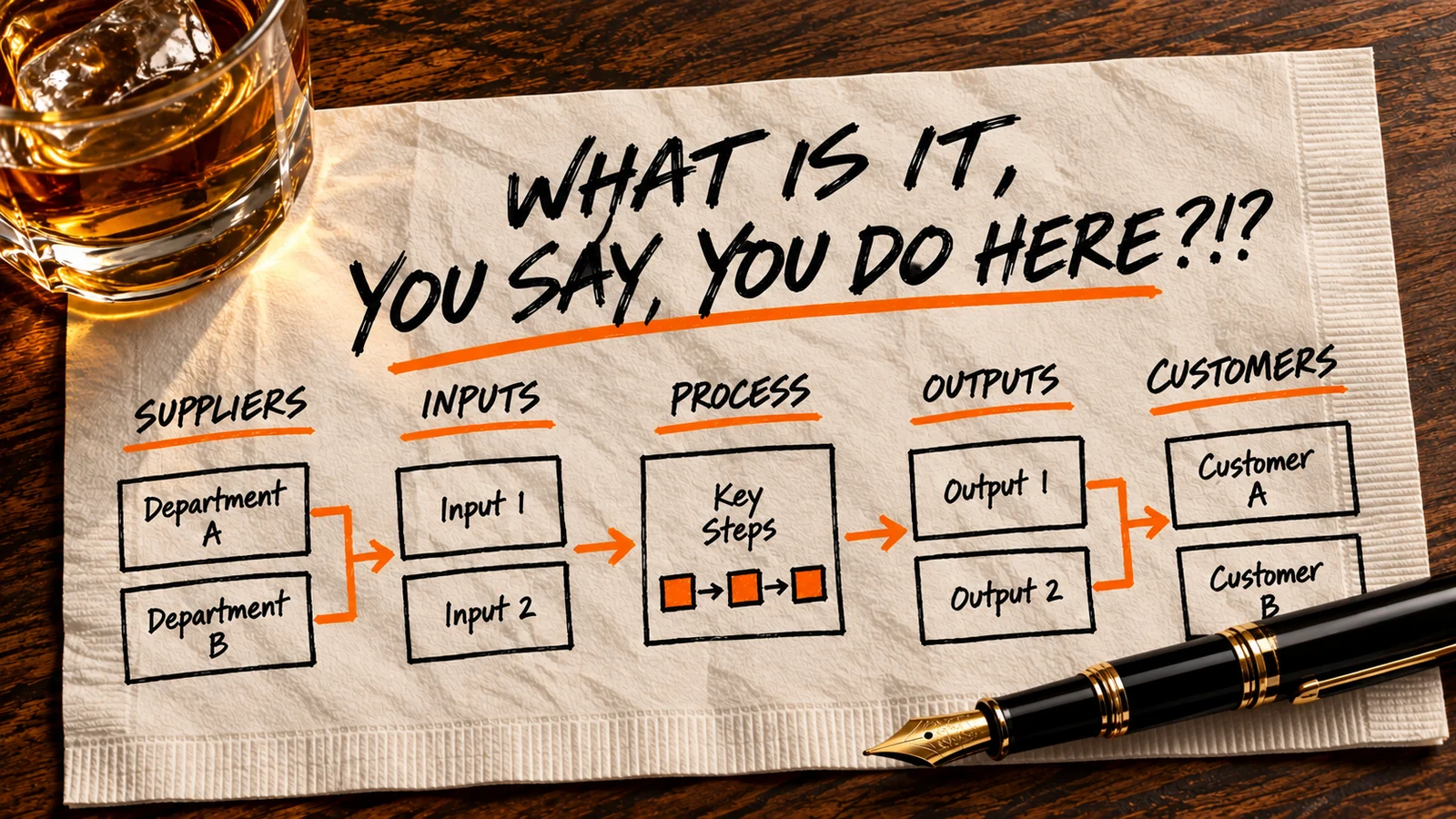
Here at APX, we strive to put Theory into Practice, and in the field of Organization Design, Development and Effectiveness, it can sometimes become overwhelming when you start peeling back the layers of an organization. One tool heavily used by Total Quality Management (TQM) in the 1980s and later by Lean Six Sigma practitioners is known as SIPOC.
But before we fully dive into the SIPOC framework, we should probably take another step back to understand this tool a little better. In the Information Technology world, IT practitioners used an Input-Process-Output (IPO) model to establish process boundaries. For a typical home computer, you could identify your inputs as a keyboard and a mouse. The computer itself would be the Process, while the outputs would be a monitor or printer.
As technology advanced, so did the inputs, processes and outputs. We now have video cameras, microphones, tablets, or even Stream Decks adding to our list of inputs. With the development of sophisticated local or web-based applications and software, the processes are far more complex than what once lived within a standalone operating system. The output list has evolved far beyond a dot-matrix paper roll to include digital information shared through cloud-based technology, augmented reality, 3D printing, or artificial intelligence.
SIPOC expands upon the IPO model by helping identify who is supplying those inputs (Supplier) and the intended audience of that effort (Customer). Think about your smartphone and what’s on it at the moment. A weather service might be the Supplier of weather information that gets processed through an app and pushed to your smartphone, with you as the Customer. If you’re a weather junkie, you may have several suppliers of weather information feeding your devices, but you’re still the Customer—because if nobody used their app, they’d be out of business.
In many cases, it might be easier to reverse-engineer a SIPOC (sometimes known as COPIS) when using the tool to improve internal processes. In other cases, the Supplier and Customer may be one and the same, depending on the end goal of that activity.
Though technology is where the IPO model originated, understanding complex organizations isn’t as easy as pointing to a single application or software package. At the Strategic level, there are different C-suite officers with different areas of responsibility (Operations, Learning, Human Resources, Information, etc.). Each of those officers has a department with several branches, sections, or teams working through several processes independently or cross-functionally. There are most likely half a dozen or more software applications, forms, PowerPoints, or emails being used to assist some process intended to achieve an organizational output.
My recommendation is always to skip the P and focus on the other aspects of the SIPOC model during the initial phase. Get your team together in a conference room with a giant whiteboard and draw a five-column table with a dry-erase marker, with the SIPOC titles across the top. Depending on the size of your team or department, write each of your team members’ names down the Suppliers column (i.e., Joe, Susan, Bob, Darleen, or Team A, Team B, Team C, etc.). This will eventually allow them to understand the “What’s In It For Me (WIIFM)” aspect.
Then hand them all a stack of Post-it notes or stickies and ask them to write down everything they produce for the organization. Think about the Two Bobs scene from the infamous Office Space movie. They should be able to write down all the things they produce during a 40-hour work week. If there is a struggle, you may want to provide the job description you used to recruit that employee.
As they’re writing down all those deliverables (i.e., Financial Report, Training, IT Security, etc.), discuss each note with the team to seek clarification and mutual agreement as you post them to the Output column of the board. As you’re going through each deliverable, ask them who they’re performing those duties for and annotate that in the Customer column.
Is that Financial Report that Joe develops every week reviewed by anyone, or is it just a wasted effort nobody reads? There have been plenty of times I’ve stopped doing something just to see if anyone noticed. Trust me, if you turn the hot water off, someone in the shower will scream. ;)
Once you’ve clearly identified your team’s contributions and for whom they perform those duties, it’s a lot easier to figure out the inputs because the conversation will divulge that information. You may be surprised to find out your team was being tasked via email (Input) by the Custodial department (Customer) for a financial report (Output) from Joe (Supplier) that you weren’t aware of, let alone the number of steps he may go through (Process) just to build that report.
Truth Improves Performance.