If you’re a small business owner, it’s usually easy to identify why something isn’t performing as expected. Problems are visible, communication is direct, and decisions happen quickly without expensive consultants or lengthy interventions.
A five-person landscaping company rarely needs an organizational consultant. If two employees are arguing after working in 95-degree heat all day, the owner isn’t developing a corrective action plan. They’re buying lunch, cooling everyone off, and getting back to work.
As a company grows into an organization, complexity increases. New functions emerge, requiring expertise you may not possess. The people you hire bring different experiences, industry benchmarks, and perspectives shaped by other organizations. Sometimes those perspectives reinforce your decisions; other times they challenge them. What began as a simple startup eventually becomes a complex system that no single leader can fully see.
You don’t even have to own the organization for this to happen. Many of us spend years becoming experts in our profession before being promoted into leadership. We master our trade, then suddenly find ourselves responsible for leading people, improving performance, and making decisions that extend far beyond our original expertise. The skills that made us successful as technical experts rarely prepare us to lead an increasingly complex organization.
But what happens when performance issues continue despite everyone’s best efforts? The quick fixes that worked in a small business rarely solve problems in a complex organization. Leadership changes. Technology evolves. Markets shift. Customer expectations change. Processes adapt. What appears to be a people problem may actually be a process problem. What looks like a training issue may be a strategic decision made years earlier.
Where do you even begin to identify root causes in such a complex world? There is no one holy grail answer, but there are some sound frameworks that have been proven to work in even the most complex of organizations. One favorite is the Levels of Warfare which is widely adopted by the military. The levels of warfare state “the strategic, operational, or tactical purpose of employment depends on the nature of the objective, mission, or task” (Dempsey, 2017). This same pattern shows up throughout organizational science. Dr. Roger Kaufman’s Mega–Macro–Micro framework describes the same progression using business language rather than military terminology.
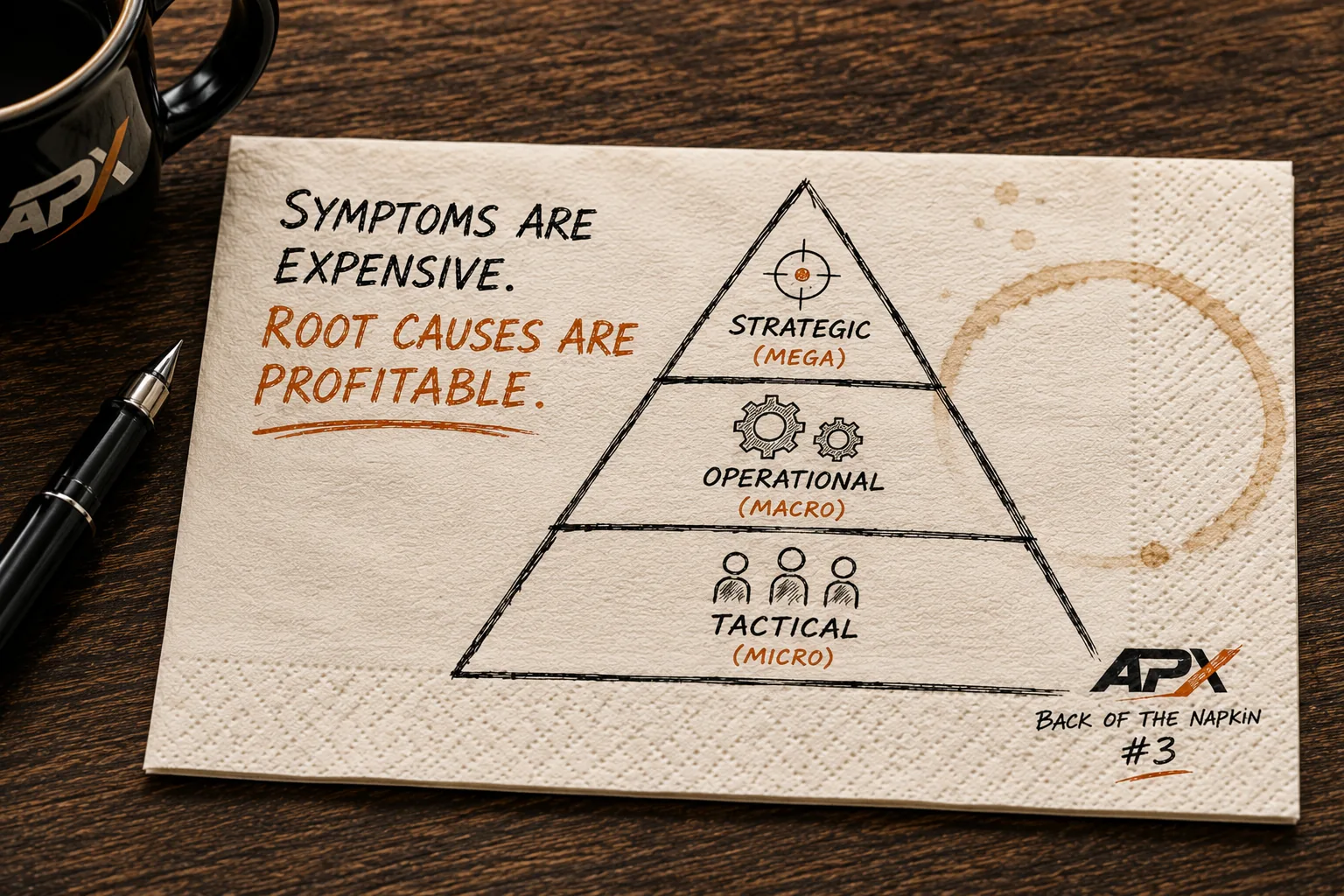
Imagine a simple three-level pyramid. The Strategic or Mega tier is at the top, where senior level leaders define the mission, strategic direction, and measures of success. In the military, this is where national objectives are translated into military strategy. In business, it’s where executives decide how the organization creates value and where it will compete. The stakes may not be military in nature, but every organization has intellectual property to protect, products or services to deliver, and customers who depend on them. Without that, there’s no need for your organization.
The middle portion of the pyramid is the Operational or Macro tier. This level is critical because those who work at this level have the responsibility of translating strategy and ensuring the work being executed accomplishes the intended outcome. Think about your department leaders; they’re not always sitting in the board room, but they are handed strategic level taskers from the higher ups and told to execute it. This is where cross-functional leadership becomes essential. Operational leaders coordinate people, processes, technology, and resources to execute strategy while managing unintended consequences that inevitably emerge.
The bottom tier of the pyramid is the Tactical or Micro level. This is where work actually happens. Individual contributors rely on leaders above them to remove barriers, establish priorities, and provide the conditions necessary for success. These are the people doing the work, the competencies that require the right amount of knowledge, skills, and attitude to ensure the performance is executed. Yes, performance is measured at all 3 tiers, but if you’ve ever read the Switch, you understand the meaning by the elephant and the rider (Heath & Heath, 2010).
All that to say, organizations are complex. There are performance requirements at every level whether you’re sitting at the C-Suite table, the Director overseeing a large department whose duties are only one function of that cross-functional organization chart, or the employee who gets up every morning to do their job and do it well. If you hear rumblings or rumors in such a complex construct, don’t be so quick to think you have the right answer to correct it. Sometimes the symptom you observed is only one variable in a much larger equation. Every time an organization solves the wrong problem, it wastes time, money, and trust. Every time it identifies the right problem, performance improves—and profitability follows.
Truth Improves Performance.